
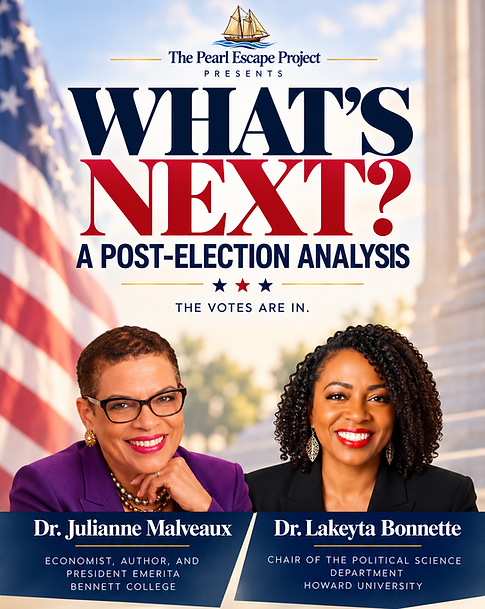
Join us just after the
midterm elections to discuss
'What's Next?'
with our expert panelists
Dr. Julianne Malveaux &
Dr. Lakeyta Bonnette.
When America Goes Backward, How Do We Move Forward?
Resisting a Second Nadir
Join Prof. Nikole Hannah-Jones in
conversation with Dr. Michael Fauntroy
As the Trump administration methodically strips away hard-won rights and upends democratic protections, what will it take to repair the damage and carve a new path forward? What must be stopped or reversed first? And which rights, policies, and safeguards must we restore, strengthen, or build anew?
Journalist Nikole Hannah-Jones joins Dr. Michael Fauntroy for an urgent conversation on the eve of the 2026 midterm elections about race, rights, and American democracy.
Hannah-Jones has warned that America may be entering a second Nadir, invoking the post-Reconstruction era when historic gains in Black citizenship, voting, political representation, and civil rights were systematically rolled back as federal protections receded. Her warning is stark: rights do not protect themselves. Without laws that are enforced, institutions that defend them, and a government willing to hold violators accountable, hard-won rights can become promises on paper rather than protections people can count on.
.png)
Just weeks before voters go to the polls, join for a discussion spanning history, voting rights, political power, and the choices ahead.
Together, Hannah-Jones and Fauntroy will explore what it could mean to prevent a second Nadir, not simply by restoring what has been lost, but by imagining a stronger and more durable agenda for race, rights, and democracy.

January - April 2026
Stories of Erasure & Resistance
The 2026 four-part series highlights experiences of oppression, cultural erasure, and resistance. Using film, historical artifacts, discussion, and testimony, the series explores how people persevere, engage, and shape the world around them.
Each program offers dialogue and connection with scholars, observers, and participants in celebrated events that have shaped and reshaped life under stress. Learning together about moments in the past that threatened existence, challenged beliefs, or changed law and custom informs our awareness of the contemporary environment in Washington, DC and beyond.
Erase the Nation
Discussion with the audience and the film's director
Tomasz Grzywaczewski
Moderated by Missy Ryan, staff writer at The Atlantic
January 22, 2026, 7PM
400 I St. SW
The series opens with a screening of Erase the Nation, an acclaimed documentary directed by Tomasz Grzywaczewski. The film chronicles Russia’s systematic destruction of Ukraine’s cultural identity and Ukraine’s steadfast refusal to be destroyed.
Not a story of loss, but a call to action, the film inspires recognition of our shared humanity and responsibility for the history, artifacts, and cultural icons that give meaning to national identity. Grzywaczewski, recognized for outstanding reporting about Kurdistan, Donbas, and Nagorno-Karabakh, will lead a discussion following the screening.
.png)
.jpg)
The Rosenwald Schools
The Remarkable Story of Collaboration in the Face of Adversity
Covered by ABC7 News - Watch here.
Register here.
Panel & Discussion with
Eugene Robinson, Alumnus & Moderator
Stephanie Deutsch, Author
Aviva Kempner, Filmmaker
Vyllorya Evans, Daughter of Rosenwald Teachers
Doris Dearing Johnson, Rosenwald Alumna


February 19, 2026
400 I St. SW
The story of the Rosenwald Schools is largely absent from American history textbooks. During the Jim Crow era between 1913 and 1932, when African American children were routinely denied education, especially in the South, philanthropist Julius Rosenwald, in collaboration with the great African American educator, Booker T. Washington, helped establish more than 5,000 schools in rural towns and smaller cities across the South.
This amazing and unsung initiative educated over 600,000 children. Among the students were Maya Angelou, John Lewis, and Alice Walker.
Why Don’t Women Vote for Women?
Panel Discussion with
Iris Harvey, former CEO of Planned Parenthood of Ohio
Shari Miles-Cowen, psychologist
Elizabeth O'Gorek, journalist
Marjorie Lightman, historian

Women are more than half the population. They vote in larger numbers than men and they are well organized. They have been able to defy convention and custom to change laws from suffrage to Title 9. Why have they not been able to elect a woman president?
The panel will offer historical and psychological insights to better understand the complexities and pressures of custom, class, and race, and of conditioning, threats and fears that underlay women’s attitudes to other women and political leadership.
.png)
Remember The Pearl!
Speakers:
Clarence Lusane, Professor & Author
Derek Musgrove, Professor & Author
April 15, 2026, 6PM
400 I St. SW
The Pearl escape was the largest non-violent escape of enslaved people before the Civil War. Though thwarted, the attempted escape forced Congress to the Compromise of 1850 which brought California into the Union as a free state, outlawed the buying and selling of slaves in the District, and assured passage of the Fugitive Slave Law, which made war inevitable.
Following two presentations and discussion, everyone will walk to the 7th Street pier where the Pearl was anchored. It is a pilgrimage of remembrance and celebration led by a Second Line New Orleans-style band. The marchers sing familiar songs of lament and glory, and at the water’s edge they will read the names of the seventy-seven enslaved men women, children, and crew who sailed in search of freedom.
Lusane and Musgrave will recount the preparations, secret networks, and interracial cooperation that made the attempt possible and lead a discussion on the enduring lessons the Pearl Incident offers about resistance, solidarity, and the preservation of freedom and identity.